
Business News
Economy in Dialogue: How Germany Can Return to a Path of Growth
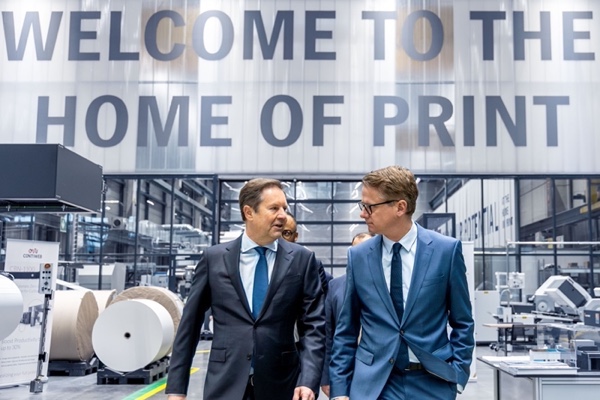
Thursday 05. February 2026 - How can Germany safeguard its economic strength, become future-proof, and return to a path of growth? This question was at the center of the Economy in Dialogue event, hosted by Heidelberger Druckmaschinen AG (HEIDELBERG) on Tuesday at its headquarters, bringing together representatives from politics and business. More than 70 decision-makers from the regional economy and the company took part in intensive discussions.
Among the discussion partners were Dr. Carsten Linnemann, Secretary General of the CDU; Christiane Staab, Member of the State Parliament of Baden-Württemberg (CDU); and Dr. Rainer Dulger, President of the Confederation of German Employers’ Associations (BDA).
In his welcome address, Jürgen Otto, CEO of HEIDELBERG, emphasized that many companies currently view the conditions in Germany as extremely challenging. “The German economy is under considerable pressure. Compared with other countries, high labor costs and energy prices, complex regulations, and bureaucratic and lengthy decision-making processes are slowing down investment and innovation. We are particularly confronted with these challenges at our largest site in Wiesloch-Walldorf. We have developed our strategy to address them,” said Otto. “The direct exchange between business and politics was very constructive. But it is also true that the essential performance improvements needed to increase global competitiveness must come from the companies themselves. Politics cannot do that for us.”
In his keynote speech, Dr. Carsten Linnemann painted a clear picture of the current situation: “Germany is in a phase of structural economic weakness. Companies are struggling not only with cyclical effects but also with fundamental locational disadvantages, particularly in terms of taxes and social contributions,” Linnemann said. “We need to regain the courage to pursue economic policy reforms—less bureaucracy, faster procedures, and clear incentives for performance and investment.”
In his remarks, Dr. Rainer Dulger also called for decisive action: “Germany now needs an economic chancellor who can combine foreign policy strength with domestic reform capability. Our country is losing momentum: a welfare state full of misaligned incentives, suffocating bureaucracy, and labor time regulations from the analog age are slowing growth and employment. Work must once again pay off in a noticeable way, education must deliver reliable quality, and Europe must lead the way in free trade and competitiveness. Only if we now make a consistent shift and refocus on value creation, performance, and growth can we safeguard prosperity, social stability, and the future viability of our country.”
During the subsequent discussion, Dr. Carsten Linnemann, Christiane Staab, and Dr. Dulger discussed pressing issues with the business representatives, including tax burdens, social contributions, securing skilled labor, energy prices, and investment barriers. Particular attention was given to the key role of small and medium-sized enterprises (SMEs) in Baden-Württemberg. All participants agreed on the need for significantly faster political decision-making processes.