
Inkjet & Digital Printing
MICRO CADD SERVICES (MCS), USES MCOR 3D PRINTING TO IMPROVE THE QUALITY AND COST-EFFECTIVENESS OF ARCHITECTURAL MODELS
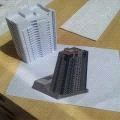
Wednesday 17. July 2013 - Many of us struggle to grasp the full implications of 2D building plans and drawings.
3D digital models, animations, and virtual fly-throughs help greatly, but nothing beats the visual communication benefits gleaned from standing around a 3D PHYSICAL MODEL.
Sometimes you just need to see the proposed building or site in three physical dimensions – even if it’s a scale replica of what’s being proposed. It’s easier to examine from different angles, understand how everything fits together, as well as communicate and share observations with the colleagues standing next to you.
That’s why Micro CADD Services (MCS), based in Bahrain in the Middle East, needed a fast and affordable way to make 3D architectural models of buildings, industrial projects and their respective sites. MCS also needed sophisticated shaping capabilities since straight lines and right angles are increasingly giving way to complex curves and organic shapes.
MCS, a full-service engineering consultant and specialist surveyors, were looking to improve on the outsourced building models obtainable from China, often taking weeks and thousands of dollars for models handcrafted from architectural drawings. In addition, sometimes models needed to go back and forth across oceans for revisions, consuming more time and money.
While MCS had studied the opportunity to service this requirement with emerging 3D printing technologies, it was only when they discovered Mcor’s approach and methodology that 3D printing became a truly viable alternative.
Dramatic cost savings
“When we saw the Mcor Matrix 300+, we were immediately drawn to its exceptional affordability,” said Ian Best, managing director for MCS. “Since it creates durable physical models from ordinary office paper, we knew we had a tremendous, low-cost alternative to outsourcing models to craftspeople in China.”
The Mcor Matrix 300+ has made striking 3D physical models for MCS in a fraction of the time and cost of handcrafting. The models are exceptionally accurate since they’re driven by precise computer data.
“By 3D printing the model ourselves, we’re spending only one-third to one-half the money we otherwise would and saving several weeks in the process,” says Best. “And because our build material is paper, we don’t have to worry about material cost as we would if we had selected other 3D printers that require expensive plastics or powders.”
3D printing an entire country
In addition to making building models, MCS has created one of the world’s largest models of an entire country, Bahrain. The 1:10,000-scale model, 5.4 meters long by 2.2 meters wide, has captivated the attention of the country’s national and local leaders, who are able to use the map for master planning.
“A 3D printed map has so much more informative than a piece of paper, a flat map or a computer screen. It’s really captured people’s imaginations and is an incredible sales tool for us, demonstrating our capabilities in a novel way,” says Best.
To create the sizeable model, MCS used Mcor’s SliceIT software to separate the digital map model into smaller tiles they could print and glue together. The software works well with edges lining up precisely, allowing them to bond together consecutive “tiles” to form a model of any size.
MCS created roads for the map by 3D printing strips of gray paper, which Best glued onto the terrain, creating a slightly elevated roadway akin to real landscapes, another benefit of working with paper as a medium.
“This massive showcase project is something that is only cost-effective because of the affordability of Mcor’s paper-based 3D printing,” says Best. “Since the build material is paper, the more we create, the lower our cost of ownership compared to other technologies.”
How about casting?
MCS recently began using the Mcor Matrix 300+ to create bronze parts. They create survey markers, for example, by 3D printing the pattern, creating a mould from the pattern, and investment casting the finished marker.
MCS appreciates that all of the models it creates are easy to sand and paint, and are recyclable when their use is finished. Given continuously improved forest management practices, Best says, Mcor is the best sustainability choice for MCS. The Mcor Matrix 300+ has also turned out to be easy to learn, easy to use and easy to maintain.
“Given all the advantages of the Matrix, we’re certain we made the right decision,” says Best. “Our customers are happy with the new capabilities that we can show them, and that drives opportunities and collaboration forward.”