
Consumables
Primed for the Challenge: Delivering Quality Results with Uncoated Paper for Labels
Thursday 19. November 2026 - Uncoated paper has always held a certain allure in the label world. Its tactile, authentic, and unmistakably premium. The fibres show character. The surface feels honest. For wine, craft beverages, personal care, luxury goods and more, uncoated paper isnt just a substrate - its part of the story.
But anyone who has tried to run uncoated paper through a digital press knows the romance can fade quickly. For all its appeal, uncoated paper remains one of the most quietly demanding substrates a converter can run in digital label production. What feels natural in the hand can behave unpredictably on the press – and that tension is where the real challenge begins. The reason is chemistry, not appearance.
Why uncoated paper resists the process
Coated papers give ink a smooth, receptive surface. Uncoated paper does the opposite. They soak. They scatter. They introduce peaks and valleys that fine detail struggles to survive. They are absorbent and often textured, and both traits pull against everything digital printing needs to deliver consistent, durable results.
The problem intensifies with heavier, thirstier papers. Take Tintoretto, the thick, structured wine paper beloved by brand owners and recognised by printers as one of the industry’s very substrates.
“One of the most challenging products is structured paper, which has peaks and valleys,” explains Andre Soterio, Key Account Manager HP and ACTDigi LEP primer expert at ACTEGA. “On a thick, absorbent wine paper, the primer often goes deep into the paper fibres, leaving no chemistry on the surface for adhesion.”
For years, converters have accepted these limitations as part of the deal. Uncoated paper was beautiful, but difficult. Premium, but inconsistent. A substrate that demanded compromise. Today, that compromise is no longer necessary.
The Primer: The Invisible Layer That Decides Everything
In digital printing, the primer rarely gets the recognition it deserves. Often treated as a formality – a box to tick before the real work begins – it is, in fact, one of the most critical components of any label construction. Primer performance is non-negotiable. The primer determines whether ink bonds, whether the OPV protects, whether the label survives moisture, handling, and time.
The primer must stay on the surface long enough to create a uniform base for ink transfer, to anchor the varnish, and support embellishments like hot foil or thermal transfer printing. Get it wrong, and the signs are unmistakable: labels that lift at the edges, ink that blurs, surfaces that cloud. No amount of downstream correction can compensate for a weak foundation. A label either holds together from the ground up, or it doesn’t hold at all.
Converters who treat the primer as a strategic component, not a commodity, are the ones achieving consistent, premium results on uncoated paper.
The Uncoated Paper Challenge: Where Good Adhesion Separates the Best from the Rest
Quality on uncoated paper is not defined by one metric. It’s defined by how the entire construction behaves under real‑world conditions.
A strong primer should prevent deep absorption into fibres, deliver uniform ink transfer even on textured surfaces, and maintain adhesion levels that pass standard tape tests with less than 5% ink removal. That gap is where the best primers prove their worth. On uncoated paper, the difference between a label that holds and one that fails often comes down to a single question: does the primer stay on the surface, or does it disappear into the fibres?
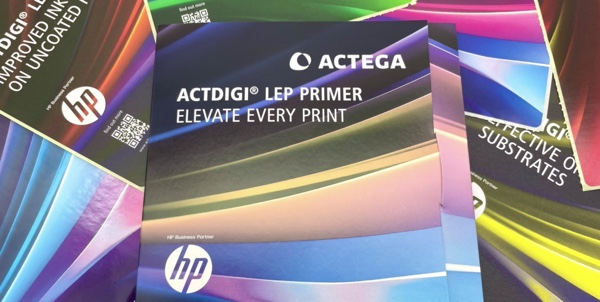
ACTEGA’s ACTDigi LEP Primer offers a clear example of what purpose-built chemistry can achieve. Developed for HP Indigo 6K, 6K+, and 8K digital presses, it is engineered to stay at the surface rather than absorb into the substrate – creating a stable foundation for ink adhesion even on the most demanding uncoated and structured stocks. Converters using the primer consistently report hitting that 95% adhesion benchmark across a wide range of materials, including challenging stocks like Tintoretto by Fedrigoni where many alternatives fall short. That level of consistency is not coincidental; it is the direct result of a formulation designed for the surfaces it needs to serve.
Andre Soterio notes; “Tintoretto might be a nightmare for every printer – but with the right primer chemistry and the right settings, we’ve seen excellent results even on that substrate.”
This is the type of performance that transforms uncoated paper from a risk into an opportunity.
A New Era for Uncoated Paper
The industry is entering a phase where converters no longer have to choose between aesthetics and performance. With better chemistry, smarter priming strategies, and more robust digital workflows, uncoated paper can finally deliver the quality brands expect and the consistency converters need. This shift is not just technical. It’s strategic.
Premium labels are increasingly judged by how they feel, how they behave under moisture, and how well they hold detail. Uncoated paper is central to that experience, and the primer is central to making it work.
Nevertheless, the primer alone won’t make all the difference without a good overprint varnish. ACTEGA recently developed a so-called Neutral Coating. This product was specially developed for HP Indigo LEP and has excellent ink adhesion and great rub resistance. Although, this overprint varnish main characteristic is related to its adaptation to the paper’s characteristics. If a printer is using a matte paper, the coating will keep this appearance. On the other hand, if a glossy paper or film is used, the gloss will remain after the OPV is applied.
If you haven’t fully evaluated your primer yet, the window to act is now. The market has evolved, the substrates have changed, and so has the standard of what good looks like. Converters who optimise their priming approach will see the results where it matters most.