
Textile Printing
Italian Textile Finishing Specialist Injects Digital Agility into Luxury Textile Manufacturing
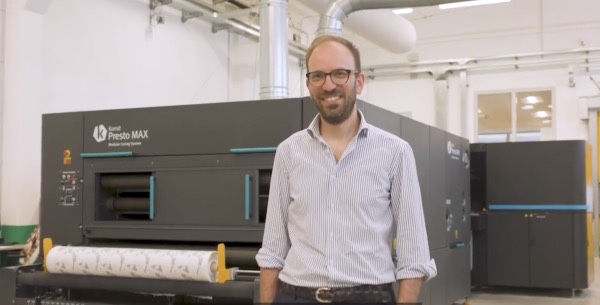
Friday 02. October 2026 - Kornit Digital shares the news that Tintoria Finissaggio 2000, one of Italys leading textile dyeing and finishing specialists, has integrated the Kornit Presto MAX into its production environment to expand its premium textile offering to improve manufacturing efficiency and support growing demand for sustainable, agile fabric production.
Designed for industrial roll-to-roll textile printing, the Presto MAX combines high-quality pigment printing with a unique single-step process that eliminates the need for pre-treatment and post-treatment. This significantly reduces water consumption, energy use and production time while enabling manufacturers to produce premium-quality fabrics on demand.
Based in Biella, one of the world’s most renowned textile manufacturing districts, Tintoria Finissaggio 2000 has been transforming fabrics since 1972. Specializing in dyeing, finishing, printing and lamination, the family-owned company has built its reputation by combining technical expertise, creativity and continuous investment in new technologies to help luxury fashion brands, textile manufacturers and fabric converters create distinctive, high-value textiles.
Driving Innovation Through Digital Transformation
For Tintoria Finissaggio 2000, innovation has always been more than adopting new equipment. It’s about expanding the possibilities of textile manufacturing.
“In Italy, we describe our work as ‘ennobling’ fabrics,” said Dino Masso, Owner and CEO of Tintoria Finissaggio 2000. “That means transforming a fabric into something better through technology, creativity and know-how. Every investment we make is about creating new opportunities for our customers, and Presto MAX represents the next evolution of that philosophy.”
Having continually expanded its capabilities over more than five decades, the company identified three strategic objectives for its next investment: developing innovative products, eliminating water from the textile printing process and creating a manufacturing platform capable of supporting increasingly customised, shorter production runs. According to Masso, Kornit Presto MAX addressed all three requirements.
“We were looking for a technology that would allow us to create something entirely new while dramatically improving sustainability,” Masso explained. “As a dye house, water consumption has always been a major consideration. Presto MAX gave us a truly water-free digital printing solution while also providing the flexibility to serve a market that increasingly demands customised, agile production.”
Redefining Premium Pigment Printing
Historically, many premium textile manufacturers associated pigment printing with a stiffer hand feel, reduced colour vibrancy and lower durability compared with traditional reactive or acid printing methods, making it less suitable for luxury applications. Working with Kornit, the company developed fabrics that exceeded those expectations, delivering exceptional colour, softness and print definition while eliminating multiple traditional finishing steps.
“When we saw the first results, we were genuinely impressed,” Masso said. “The quality, the hand feel and the appearance exceeded our expectations. That was the moment we knew we had made the right investment.”
Because fabrics emerge fully finished from the printing process, without the need for washing, steaming or additional post-processing, the company has significantly reduced production time while improving operational efficiency and responsiveness.
Enabling the Future of Textile Manufacturing
Today, Presto MAX is fully integrated into Tintoria Finissaggio 2000’s manufacturing workflow, enabling the company to develop entirely new products, serve previously inaccessible markets and support brands seeking more sustainable, demand-driven production models.
“We don’t see Presto MAX simply as a printing machine,” Masso concluded. “It’s a platform that changes the way we serve the market. As the textile industry moves toward producing only what is needed, technologies like this will be essential for building a faster, more sustainable and more flexible supply chain.”