
Prepress
Fuji Xerox Develops Technology to Recognize Handwritten Characters Using Mechanism of Visual Information Processing
Thursday 18. April 2013 - Recognizes 30,000 Characters of Multiple Languages
Fuji Xerox Co., Ltd. has developed a technology that can recognize characters by creating software that mimics the mechanism of human visual information processing, which has become better understood due to the progress in the field of neuroscience.(Fig.1)
With a focus on the inhibitory activityNote1 of human brain cells, Fuji Xerox incorporated a new structure that carries out a corresponding activityNote2 into the software to recognize approximately 30,000 characters of multiple languagesNote3. The software is the first in the world to be commercialized using a technology that incorporates this structure.
With the technology, the software learns characters like humans do. Humans learn how to read characters by repeatedly learning how to read them from childhood. In a similar manner, the technology enables the software to register characters having different shapes and to learn, and thus become able to read characters regardless of whether they are printed or handwritten. Additionally, by making the software learn characters of various countries, it becomes able to recognize multiple languages.
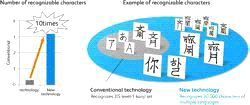
The technology recognizes approximately 30,000 characters, 10 times more than the conventional technologyNote4 that recognized approximately3,000 characters.
Fuji Xerox will utilize the technology for its services to accelerate its support for business communication.
Note1
An activity called “cross-orientation suppression,” which refers to the phenomenon of not responding when a single stimulus is presented but changing responses when the stimulus is presented together with other stimuli.
Note2
A structure that basically consists of an excitatory input and an inhibitory input as a pair.
Note3
Japanese, Chinese, and Korean languages
Note4
The technology that recognizes JIS level-1 kanji set
Fig 1. Character Recognition Technology using the Mechanism of Human Visual Information Processing
The upper diagram shows the mechanism of visual information processing in the human brain as discovered by neuroscience. Visual information input from the retina is transmitted to the primary visual cortex (V1) which extracts various angles of lines. Visual information is then relayed to the secondary visual cortex (V2) which recognizes figures consisting of two lines such as crosses and corners, before being relayed to recognize more complex figures. It is believed that the human brain processes visual information in such a hierarchical way in order to recognize various shapes and figures, ranging from simple lines to such complex objects as characters or faces.
The lower diagram explains the character recognition technology that uses the mechanism of human visual information processing, which Fuji Xerox has used in developing the software. Convolution units that extract angles and shapes of lines, such as crosses, and the sub-sampling units that put together the extracted features correspond to areas of the human brain, such as V1 and V2. Like the hierarchical processing in the brain, the convolution units and sub-sampling units are layered to extract features of characters. Finally, the character classifier identifies characters based on the extracted features. Fuji Xerox introduced a structure that realizes the process corresponding to cross-orientation suppression when putting together features in the sub-sampling units, and thus succeeded in recognizing approximately 30,000 characters through distinguishing based on minute differences.